What is Sulforaphane and what does it do?
We all know broccoli is good for us — but why, exactly?
The answer isn’t vitamins. It’s a molecule called Sulforaphane, one of the most researched plant compounds in nutritional science. Sulforaphane is a natural plant compound found in cruciferous vegetables such as broccoli, broccoli sprouts, kale and cabbage.
Sulforaphane is best known for its role in supporting the body’s natural detoxification pathways and helping protect cells from oxidative stress. Because of these properties it has become one of the most widely studied plant compounds in the field of nutrition and functional health. Research has explored Sulforaphane for its potential role in supporting cellular health, immune balance and the body’s natural defense systems. Broccoli sprouts are one of the richest natural sources of Sulforaphane, containing significantly higher levels of its precursor glucoraphanin than mature broccoli. This is why broccoli seed and sprout based supplements are often used to deliver a concentrated source of this powerful compound.
From dormant molecule to cellular bodyguard
Sulforaphane is a naturally occurring compound produced by cruciferous vegetables as a defence mechanism against insects and pathogens. But it isn’t pre-formed in the plant. The plant is smarter than that.
Inside the plant, two things are stored separately: glucoraphanin (an inactive precursor) and myrosinase (an enzyme). When the plant is damaged — chewed by an insect, or by you — the
two come into contact. The enzyme converts the precursor into sulforaphane: biologically active and immediately ready to work in your body. Broccoli sprouts are particularly extraordinary. They contain up to 100 times more glucoraphanin than mature broccoli — making them the most concentrated natural source of sulforaphane potential on earth. A small handful of raw sprouts can deliver what would take kilos of cooked broccoli, if the conversion happens correctly.
The Nrf2 pathway — your body’s master defence switch
How one molecule turns on hundreds of protective genes.
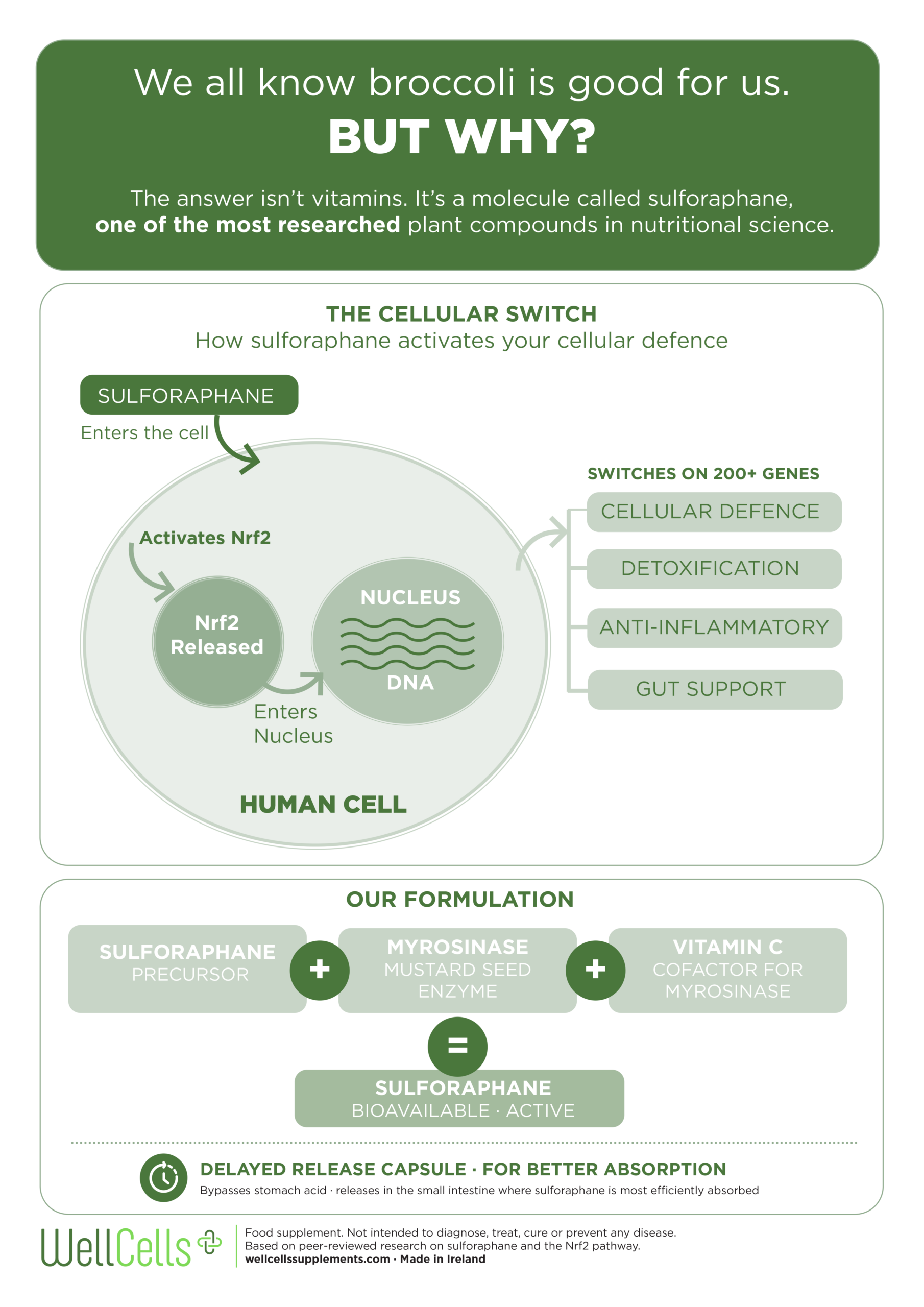
Inside virtually every cell in your body sits a protein called Nrf2 — held dormant, like a switch in the off position. Most things leave it there. Sulforaphane releases it.
Once active, Nrf2 travels to the cell nucleus and switches on over 200 cytoprotective genes that govern antioxidant production, detoxification, and cellular repair. Rather than acting as an
antioxidant itself, sulforaphane activates your body’s own antioxidant machinery — a selfamplifying response that lasts far longer than any supplement could. A single dose can sustain
Nrf2 activation for 24–72 hours.
Specifically, it upregulates glutathione (the body’s most abundant endogenous antioxidant), activates Phase II detoxification enzymes, suppresses NF-κB (a key driver of chronic
inflammation), and induces autophagy — the cellular self-cleaning process that declines with age. This is why sulforaphane isn’t just another wellness ingredient. It doesn’t top up a single nutrient.
It activates a system.
What the science actually says – brain, gut, metabolism, inflammation, longevity
Sulforaphane is one of the most studied plant-derived compounds in nutritional science — with research spanning Johns Hopkins, Harvard, Stanford, and the NIH. What’s unusual is the
breadth: most compounds get studied in one or two areas. Sulforaphane has credible, peer reviewed evidence across brain health, metabolic conditions, detoxification, gut health,
cardiovascular function, and healthy ageing.
Crucially, much of this evidence comes from human clinical trials, not just laboratory or animal studies — which is rare for a plant-derived compound. The body of evidence is unusually
consistent, and it keeps growing. Scroll down for the detail on each area, including the specific trials and what they showed.
Why eating broccoli isn’t enough
Gut Health
The gut plays a central role in immunity, inflammation, and overall wellbeing, and Sulforaphane has been widely studied for its protective effects on the digestive system. Research suggests Sulforaphane helps support the integrity of the gut lining – he barrier that prevents things leaking from your gut into your bloodstream, while promoting a healthier inflammatory response within the digestive tract. Studies have also explored its potential role in supporting beneficial gut bacteria and it appears to support a healthier balance of gut bacteria overall, encouraging the beneficial strains and suppressing the harmful ones. By supporting the gut environment and reducing oxidative stress, Sulforaphane helps create the conditions for improved digestion, comfort, and overall gut balance. Sulforaphane has been shown to directly kill H. pylori (H. pylori is a stubborn stomach bacteria) with human studies showing regular broccoli sprout consumption measurably reducing bacterial load in the stomach.
Cellular Defence
Every day, our cells are exposed to oxidative stress from pollution, processed foods, stress, and environmental toxins.
Sulforaphane is one of the most researched natural compounds for activating the body’s own cellular defence systems. It works by stimulating Nrf2, which helps increase the production of protective antioxidant enzymes such as glutathione. This process supports detoxification pathways, protects cells from oxidative damage, and helps the body maintain long term cellular resilience.
Scientific literature has linked Sulforaphane to healthy ageing, cognitive support, and protection against inflammation driven cellular stress.
Energy
Sulforaphane supports natural energy production at a cellular level. Research shows Sulforaphane activates the Nrf2 pathway, often referred to as the body’s master antioxidant switch, helping protect mitochondria from oxidative stress and supporting efficient cellular energy production. Unlike stimulants like coffee that provide temporary energy spikes, Sulforaphane works by helping the body produce and preserve energy more efficiently from within.
Emerging studies also suggest Sulforaphane may support mental clarity, reduce fatigue linked to inflammation, and promote resilience against everyday stressors.
Skin
Healthy skin starts beneath the surface, and Sulforaphane has been studied for its ability to support skin health through antioxidant and anti inflammatory pathways. By helping reduce oxidative stress and supporting the body’s natural detoxification systems, Sulforaphane may contribute to clearer, brighter, and more resilient skin.
Research also suggests it can help protect skin cells from environmental stressors such as UV exposure and pollution, both of which accelerate visible ageing. Through its support of collagen protecting pathways and cellular renewal, Sulforaphane helps nourish skin health from within.